
When a Flat Roof Needs Repair and When It Needs to Be Replaced: A Property Owner’s Decision Guide
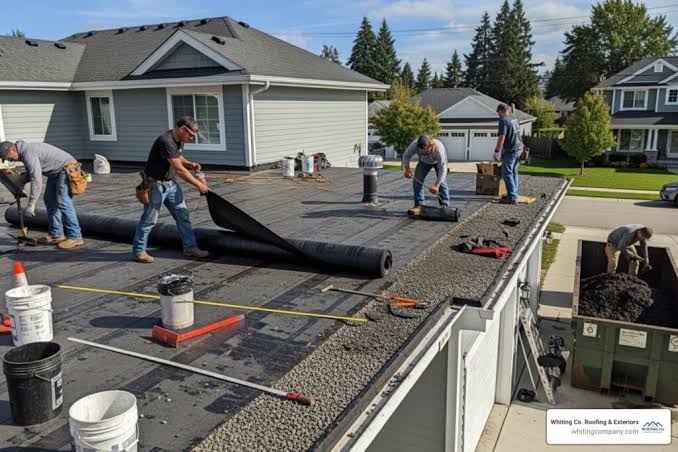
Flat roofs fail in specific, diagnosable ways. The membrane separates at a seam. Water pools in a low section and stays there for days. Flashing lifts away from a parapet wall after years of thermal expansion and contraction. Each of these failures tells you something different about the roof’s condition, and each one points toward a different course of action.
When considering flat roof repair, the question property owners face after a flat roof fails is not just “how do I fix this?” It is “should I repair what is failing or replace what is there?” Getting that call right determines whether you spend a moderate amount now or a much larger amount in two years when the same roof fails again.
This guide walks through how flat roof systems fail, what the diagnostic process looks like, and the specific conditions that point clearly toward repair versus replacement.
How Flat Roof Systems Fail
Flat roofs use a membrane system (TPO, EPDM, modified bitumen, or built-up roofing) to keep water out. Unlike sloped roofs, flat roofs rely entirely on the integrity of that membrane and its seams, because water does not run off quickly. Any breach, no matter how small, allows water to travel laterally beneath the surface before it enters the building. This is why a leak inside the building often surfaces far from the actual point of entry.
The three most common failure modes are:
Seam separation. Membrane sections are joined at seams using heat welding (TPO) or adhesive (EPDM). These seams carry significant stress from thermal cycling, and they are the most frequent failure point on older flat roofs. A separated seam does not always produce an immediate, visible leak. Water may track along the underside for weeks before it reaches the interior.
Ponding water damage. Ponding is defined as water that remains standing on the roof surface for 48 hours or more after a rain event. Short-term ponding is a drainage issue. Chronic ponding accelerates membrane degradation, increases the hydrostatic load on seams, and — over time — can cause the insulation beneath the membrane to compress and lose its structural support function. A roof with widespread ponding has a drainage problem, a structural problem, or both.
Flashing failure. Flashing seals the transition between the membrane field and any vertical surface: parapet walls, rooftop equipment curbs, pipes, and HVAC penetrations. Failed flashing is the leading cause of commercial flat roof leaks because these transition points experience the most movement. When the sealant cracks or the metal pulls away from the wall, water enters at the perimeter rather than through the field of the membrane.
What the Diagnostic Process Looks Like
A flat roof leak diagnosis starts with a full roof inspection, not a patch. A competent inspector walks the entire membrane field, checks every seam and penetration, tests suspect sections, and, when the leak path is unclear, uses a water test or infrared scan to locate wet insulation and trace the entry point.
The diagnostic step matters because:
- The visible damage inside the building (a stain on the ceiling, a wet wall) is almost never directly below the entry point.
- Patching the wrong location produces a repair that fails within a season.
- An infrared scan on a roof with extensive wet insulation may reveal that damage covers a much larger area than the single active leak suggests.
The goal of the inspection is a written scope: the failure point, the extent of damage, and the recommended repair or replacement with a clear explanation of why.
Repair vs. Replacement: The Specific Conditions That Decide It
Repair is the right call when:
The membrane is generally sound, and the damage is isolated. A single seam failure, a failed flashing section, or a localized ponding zone on a roof that otherwise shows good membrane integrity is a repair situation. Isolated damage on a relatively young membrane (one that has not yet reached the manufacturer’s expected service life) almost always warrants repair over replacement.
The repair can be matched to the existing system. TPO patches to TPO, EPDM patches to EPDM. A well-matched patch on a sound field membrane, properly heat-welded or bonded, performs for years.
Replacement is the right call when:
The membrane shows widespread deterioration. Cracking across the field surface, brittleness, widespread seam lifting, and multiple active failures spread across different sections of the roof are indicators that the membrane has reached or exceeded its service life. Patching one section of a deteriorated membrane leaves the rest of the deterioration in place.
The insulation is saturated across a large area. Water-saturated insulation loses its thermal and structural value. When infrared scanning or core sampling reveals that wet insulation covers a significant percentage of the roof area, the cost and complexity of replacement begin to approach, or exceed, the cost of continuing to repair.
The drainage problem is structural. If ponding water results from deflection in the roof deck rather than a blocked drain, repairs to the membrane will not solve the underlying problem. The water will continue to pond, and the repairs will continue to fail.
The repair-to-replacement cost ratio no longer favors repair. A general benchmark: when the cost of a repair exceeds 25–30% of replacement cost, or when the roof has required multiple repairs within a short period, replacement delivers better long-term value. A reputable contractor will present both options with written scopes so you can compare directly.
What to Ask Before Any Work Begins
Before authorizing a flat roof repair or replacement, ask the contractor to walk you through four things in writing: the identified failure point, the extent of damage found during inspection, the scope of the proposed work, and the expected service life of the repair or the new system. Apple Roofing understands the importance of a thorough diagnostic approach to help property owners make informed decisions about their roofing systems.
A written scope also gives you a document to reference if the work underperforms, and it lets you compare bids on equal terms rather than guessing which contractor is proposing the same scope as another.
Media Contact:
Company Name: Apple Roofing
Phone: (402) 576-5926
Address: 14218 S 220th St
City: Gretna
State: NE
ZIP Code: 68028
Country: United States
Website: https://appleroof.com/gretna-ne/
Social Media:
https://www.facebook.com/appleroofing
https://www.linkedin.com/company/apple-roofing-llc/